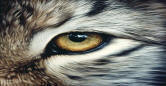







Lynx primarily hunt by sight, but also use their well-developed hearing. They mainly stalk prey at night.
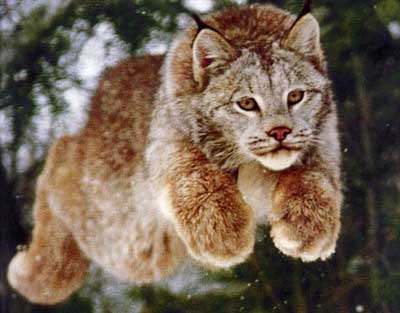
A 30 pound lynx has bigger feet than a 200 pound mountain lion. Their big feet act like snowshoes, allowing them to hunt effectively even in deep snow.
Lynx are very vocal. They can make an amazing variety of hissing, chattering and yowling sounds.
Lynx populations rise and fall in sync with the population cycles of snowshoe hares. When hares are abundant, more lynx survive to reproduce and their numbers increase.
When hare populations crash, about every 10 years, many lynx die of starvation.
Although females continue to breed and reproduce they difficulty supporting both themselves and their young on a reduced food supply resulting in fewer kits surviving.
State and federal biologists have been searching for a trace of the Canada lynx, the only lynx that lives in the lower 48 states.
Since an actual sitting may be too much to ask, they are looking for any sign that Canada lynx have a continued presence in Utah, even a few lynx hairs.
Of the 16 lynxes born in Doñana between 1993 and 1994, only two are known to survive.
Five were shot, three were hit by vehicles and the remaining six haven't been located for some time.
Recent censuses indicate a maximum of about 500 lynxes in Spain, while isolated populations exist in Portugal.
It's the most endangered cat species in the world. Hunters and trappers have exploited Canadian lynx for their fur since the 17th century.
As the large-cat fur trade grew more restrictive in the 1960s and '70s, and as trapping led to the subsequent reduction of ocelot and margay populations, trappers focused their attention on the pelts of Canadian lynx.
However, the lynx population is most affected by the size of the hare population, not trappers.
Lynx help control snowshoe hare and other small-mammal populations that humans often consider pests.

Front Hind
Straddle: 18 cm
(7.2 in)
Stride: 30 - 36 cm (12 - 14.4 in)
Track: 10 cm (4 in) long / 10 cm (4 in) wide