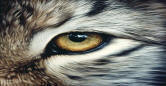







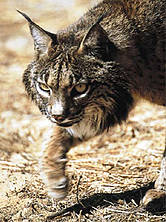
Lynx common name for a wild Carnivore characterized by its odd long legs and large, heavy paws. Lynxes live throughout the temperate and sub arctic regions of the Northern hemisphere. They are stout-bodied animals, 65 to 130 cm (26 to 51 in) in length, with thick, soft fur and short, stubby tails. Most species have a tuft of hair, more than 2 cm long, at the tip of each ear.
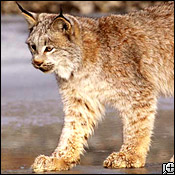
Scientific classification: Lynxes belong to the family Felidae. The Spanish lynx is classified as Lynx pardinus, the bobcat as Lynx rufus, the Eurasian lynx as Lynx lynx, and the Canadian lynx as Lynx canadensis.
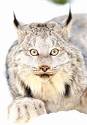
Click to view videos
A 30 pound lynx has bigger feet than a 200 pound mountain lion. Their big feet act like snowshoes, allowing them to hunt effectively even in deep snow.
Lynx are very vocal. They can make an amazing variety of hissing, chattering and yowling sounds.
Lynx populations rise and fall in sync with the population cycles of snowshoe hares. When hares are abundant, more lynx survive to reproduce and their numbers increase.
When hare populations crash, about every 10 years, many lynx die of starvation.
Although females continue to breed and reproduce they difficulty supporting both themselves and their young on a reduced food supply resulting in fewer kits surviving.